Data model
The tables created by pimdb are part of two different data models:
- The dataset model as created by
pimdb transfer. - The normalized model as created by
pimdb buildand derived from the tables of the dataset model.
The main difference is that the tables dataset model are basically a copy of the flat datesets, while the normalized model has normalized relations and several data quality and naming issues cleaned up.
This chapter describes both kinds of tables and gives examples on how to query them.
Dataset tables
The data are transferred "as is" except that duplicates are skipped. Most
of the time the datasets do not include duplicates, but every once in a while
they do, especially names.basic.tsv.gz.
You can find a short description of the datasets and the available fields at the page about the IMDb datasets.
Dataset tables have their names in PascalCase, for example TitleBasics
while the field names preserve the original camelCase, for
example runtimeMinutes.
Typically queries will start from either NameBasics or TitleBasics
and from there join into other tables. Data about names are connected with the
field nconst while data about titles use tconst. The only exception
is TitleAkas which has its tconst stored in titleId.
The tables have no foreign key relations to other tables for the following reasons:
- At the time of this writing, the datasets include minor inconsistencies that would break the data import due to unresolvable foreigen key relations.
- Without foreign key relations is easily possible to
pimdb transfermultiple tables in parallel.
Here is an example query that lists all the titles directed by Alan Smithee:
-- Example query: titles directed by Alan Smithee
select
    TitleBasics.primaryTitle as title,
    TitleBasics.startYear as year,
    TitleBasics.titleType as type
from
    TitleCrew
    join TitleBasics on
        TitleBasics.tconst = TitleCrew.tconst
    join NameBasics on
        find_in_set(NameBasics.nconst, TitleCrew.directors) > 0
where
    NameBasics.primaryName = 'Alan Smithee'
order by
    TitleBasics.startYear,
    TitleBasics.primaryTitle
The tables have very few indexes, typically only the key fields nconst and
tconst are indexed. So SQL joins on these fields should be reasonably
fast while for example SQL where conditions on name fields are pretty
slow.
You can add your own indexes at any time but be aware that too many indexes
might slow down future runs of pimdb transfer. Also they take more
space. And finally, if you use the command line option --drop, they are
removed and you will have to create them again.
Normalized tables
While the dataset table are already sufficient for many simple queries, they
have several issues that normalized tables created with pimdb build
solve:
- 1:N relations are stored in relation tables instead of comma separated
varcharfields. For exaple, compareNameBasics.knownForTitleswithname_to_known_for_title. - Inconsistent or non-existent references are removed and replaced by clean foreign key relationships.
- SQL joins can be performed more efficiently using integer
idfields instead of thevarcharfieldsnconstandtconst. If needed, the latter are still available fromname.nconstandtitle.tconst. - Ratings from
TitleRatings(dataset:title.ratings) have been merged withTitleBasicsintotitle.average_ratingandtitle.rating_count. For titles that have no rating, these values are both 0.
Normalized tables are named using snake_case, for example title_alias,
and so are fields in these tables, for example primary_title. This makes
it easy to know whether a table is a dataset or normalized.
Let's take a look at these tables and how they are related to each other.
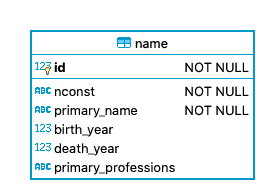
First, there is name which contains information about persons that one
way or another contributed to a title:
Next, there is title which is somewhat similar to name but contains
details about titles. It also has relation to title_type, which is a
key table containing all available title types, for example: "movie",
"tvEpisode" and so on. Apparently there are only a few different such types,
so this table is pretty small. Similarly there is a table genre with
names like "Action", "Sci-Fi", "Documentary" and so on. Because a title can
have multiple genres, they are connected in a relation table
title_to_genre in order to represent this M:N relation.
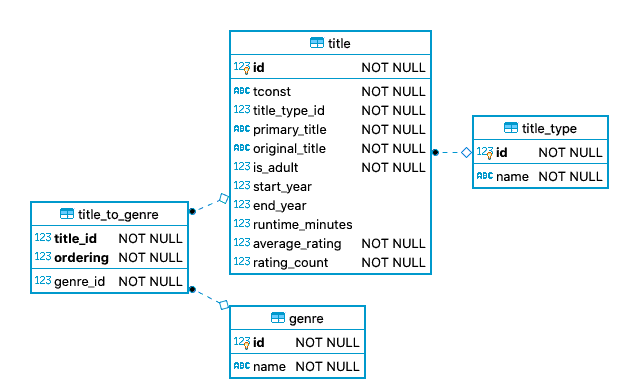
As example here is a query to list the genres of a certain title:
-- Example query: genres of "Wyrmwood: Road if the Dead"
select
    title.tconst,
    title.primary_title,
    genre.name as "genre.name"
from
    title
    join title_to_genre on
        title_to_genre.title_id = title.id
    join genre on
        genre.id = title_to_genre.genre_id
where
    title.tconst = 'tt2535470'
The output would be:
| tconst | primary_title | genre.name |
|---|---|---|
| tt2535470 | Wyrmwood: Road of the Dead | Action |
| tt2535470 | Wyrmwood: Road of the Dead | Comedy |
| tt2535470 | Wyrmwood: Road of the Dead | Horror |
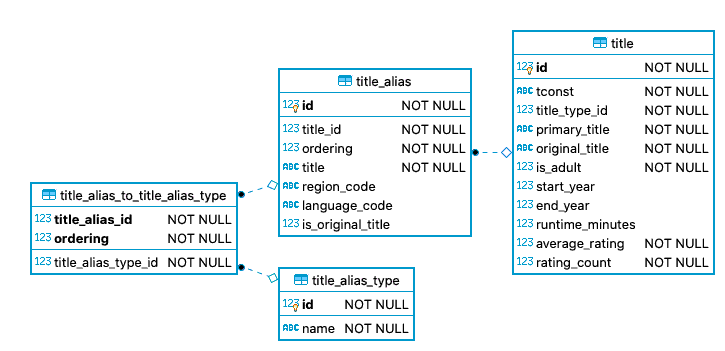
Similarly, a title be known under different names, for example depending on
the country or media released on. A title_alias is related to exactly one
title and can have multiple aliases. They are connect with the relation table
title_to_alias and have a certain title_alias_type like "dvd", "tv" or
"festival".
And finally names and titles can be related to each other. A simple variant are the titles a person is known for:
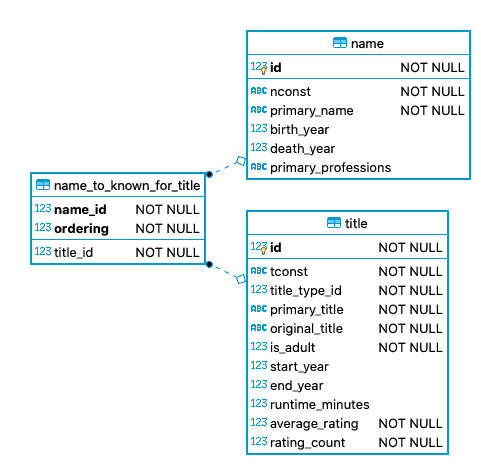
As example, here is a query that lists the titles Alan Smithee is known for:
-- Example query: titles Alan Smithee is known for
select
    title.primary_title,
    title.start_year
from
    name_to_known_for_title
    join name on
        name.id = name_to_known_for_title.name_id
    join title on
        title.id = name_to_known_for_title.title_id
where
    name.primary_name = 'Alan Smithee'
More details on how a person contributed in the makeing of a title are avaiable
via the participation table, which connects names and titles with a
profession like "actress" or "director". For professions like "actor" and
"actress" there also is information on which character(s) they played in a
certain title using the relation table participation_to_character and the
key table character. Unlike most other key table that have only a couple of
entries, character has about two million.
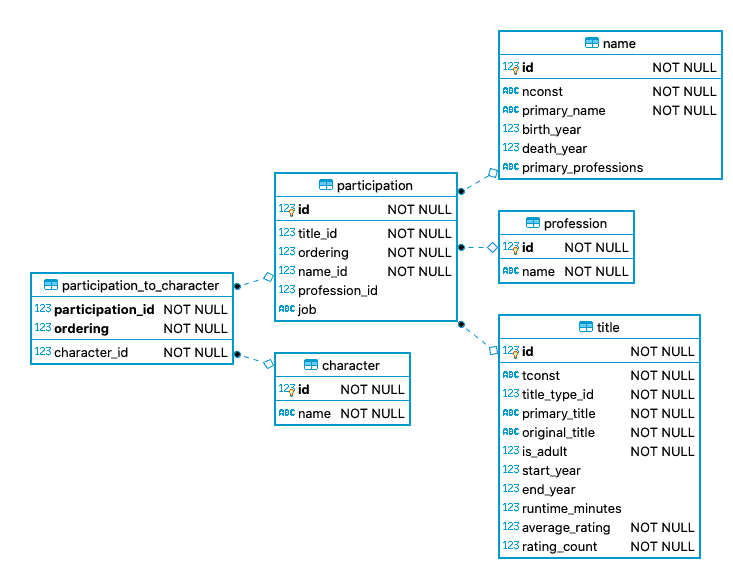
Note that not everyone actually played a character as a title typically has
many supporting roles. Depending on the goals of your query you might have to
use a left join for participation_to_character.
-- Example query: movies with a character named "James Bond" and the respective actor
select
    title.primary_title as movie,
    title.start_year as year,
    name.primary_name as actor
from
    title_character
    join title on
        title.id = title_character.title_id
    join name_to_title_character on
        name_to_title_character.title_character_id = title_character.id
    join name on
        name.id = name_to_title_character.name_id
where
    title_character.name = 'James Bond'
order by
    title.start_year,
    title.primary_title